Skeet
The Call of the WildSkeet is a little Irish setter whose practical tenderness gives her a distinctive place in Buck’s life after John Thornton rescues him. She is not defined by dominance, speed, or violence, but by care: when Buck is starving and injured, she treats his wounds each morning. Her devotion later becomes absolute when she dies beside Thornton, making her both a companion in his domestic circle and a final witness to the destruction of that circle.
Identity and Introduction
Skeet appears during Buck’s recovery on the riverbank, where John Thornton, Skeet, and Nig are waiting for the raft that will carry them down to Dawson. Thornton is still recovering from the injury that left him limping, while Buck, after traveling three thousand miles, is lying exhausted and wounded. In this setting of enforced rest, Skeet’s character is introduced through an act of bodily attention rather than through pedigree, command, or combat.
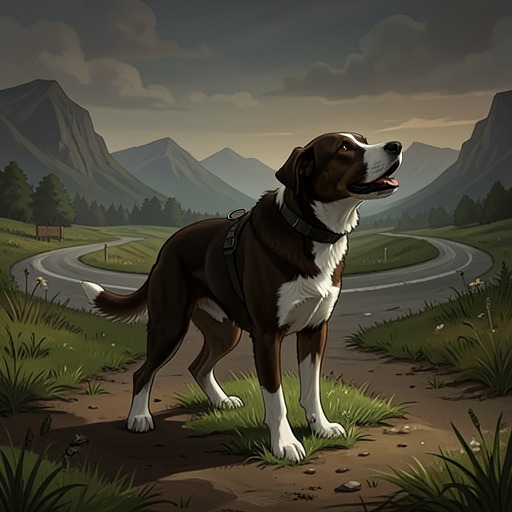
She is specifically described as a little Irish setter with what the narrative calls the doctor trait found in some dogs. Buck, then too weak to resist her first advances, becomes the recipient of her self-appointed treatment. Her small size does not limit her usefulness; she assumes responsibility for cleansing the wounds of a much larger dog and repeats the task with dependable regularity.
Care During Buck’s Recovery
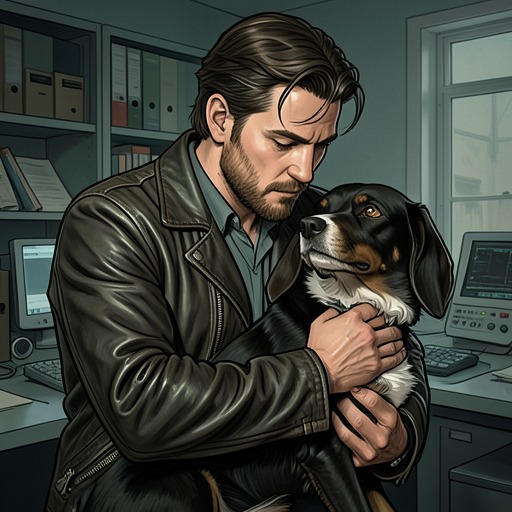
Each morning, after Buck has finished breakfast, Skeet washes and cleans his wounds. She continues until the treatment becomes part of his expected routine, something he looks for almost as much as John Thornton’s care. Her ministrations therefore do more than relieve physical injury. They establish a recurring relationship in which Buck, who has been subjected to harness discipline, starvation, beatings, and exhaustion, is approached through gentleness rather than force.
Skeet’s care belongs to a wider pattern around John Thornton. Nig is equally friendly, though less demonstrative, and possesses a boundless good nature. Neither dog shows jealousy toward Buck. Instead, both seem to share Thornton’s kindness and emotional largeness. As Buck regains strength, Skeet and Nig draw him into foolish games, and Thornton joins them. Skeet thus helps transform convalescence from mere physical repair into the beginning of a different existence for Buck.
This contrast matters because Buck’s earlier bonds had been based on other forms of association. His relationship with Judge Miller had involved hunting and travel as a working partnership, his relation to the Judge’s grandsons had resembled formal guardianship, and his relation to the Judge himself had been a dignified friendship. With Skeet’s wound-cleaning and the playful household at Thornton’s side, Buck encounters a form of affection that is neither service nor discipline. Skeet is one of the agents through whom that new emotional world becomes concrete.
Companion to John Thornton’s Household
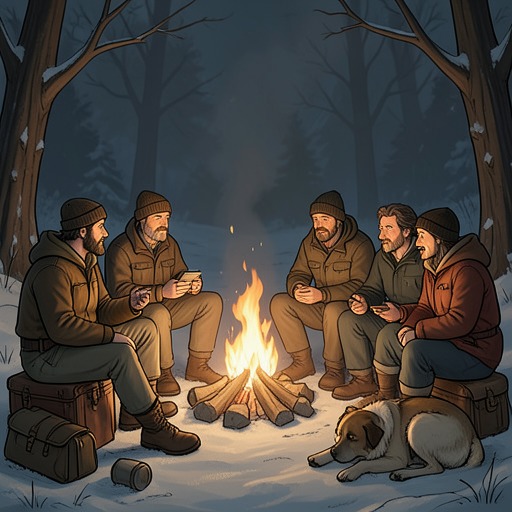
Skeet’s presence helps define the small community that gathers around John Thornton. Thornton treats his dogs as if they were his own children, remembering kind greetings and cheering words and taking pleasure in long conversations with them. Skeet’s regular care of Buck mirrors this ethic in canine form: she does not merely coexist with the rescued dog but responds to his vulnerability as a responsibility.
Her relationship with Buck is especially significant because it is free of rivalry. Elsewhere, sled dogs are organized by work, rank, correction, and competition. Dave and Solleks teach Buck through their teeth; Spitz fears the challenge to his authority; and the pride of the traces drives dogs to remain in harness even when labor destroys them. Skeet operates outside that hierarchy. Her value is expressed through healing and companionship, showing that canine life in the novel includes cooperation and solicitude as well as struggle.
Her actions also make the dogs active participants in Buck’s recovery rather than decorative reflections of human feeling. John Thornton saves Buck’s life, but Skeet cleans the wounds, Nig keeps watch through his howl, and both dogs invite Buck into play. The recovery is therefore a shared, cross-species process. Human kindness establishes the conditions for survival, while canine care and companionship help make survival worth inhabiting.
Loyalty in the Forty Mile Creek Rapids
Skeet is present when John Thornton later risks his life on the Forty Mile Creek. Thornton and his partners, Hans and Pete, are guiding a narrow poling boat through dangerous rapids. From the bank, Buck follows anxiously, never taking his eyes off his master. The scene establishes the intensity of the bond linking the dogs to Thornton, and Skeet belongs to the same loyal circle even though Buck performs the physical rescue.
When Thornton is thrown into the current and carried toward water in which no swimmer could live, Buck launches himself after him. The rescue nearly kills them both: Thornton is dragged through the rapids, and Buck suffers three broken ribs before he is brought ashore. Once Thornton regains consciousness, his first concern is Buck. Skeet is already beside the apparently lifeless dog, licking his wet face and closed eyes, while Nig howls over him. Her response repeats the pattern established during Buck’s convalescence: in crisis, Skeet attends to the wounded body.
The outcome confirms that her care is not limited to Buck’s first recovery. She remains close through the violence of the rescue and helps sustain the emotional and physical solidarity of Thornton’s group. Thornton orders the party to camp until Buck’s ribs have knitted, and Skeet’s presence beside him makes the decision part of a mutual obligation rather than a calculation of immediate usefulness.
Death and Narrative Significance
Skeet’s final appearance comes after the Yeehats attack the camp. Buck returns from driving the attackers away and finds Pete dead in his blankets and signs of John Thornton’s desperate struggle leading to a deep pool. Skeet lies at the edge with her head and forefeet in the water, faithful to the last. The pool conceals Thornton’s body, but Buck follows the trace into the water and finds that no trace leads away.
Her death is important precisely because it is quiet beside the larger violence of the scene. Buck becomes a terrifying avenger, killing Yeehats and acquiring the reputation of an evil spirit, but Skeet’s body records another kind of action: she remained with Thornton until the end. Her fidelity gives the massacre a personal and domestic dimension. The lost camp is not merely a place abandoned by its inhabitants; it is the ruined home in which care, play, and companionship had briefly allowed Buck to experience passionate love.
Skeet therefore functions as more than a minor companion. She embodies the cooperative and nurturing capacity of dogs in a world that repeatedly treats them as transport, property, or instruments of endurance. Her wound care, friendship, participation in Buck’s convalescence, attention after the rapids, and death beside Thornton create a counterpoint to the law of club and fang. When Thornton dies, Buck feels a void like hunger that food cannot fill; Skeet’s absence deepens that loss, because she was one of the living presences that made Thornton’s world humane. Through Skeet, the narrative gives canine loyalty a physical practice—washing wounds, staying near the injured, and refusing to abandon the dead—rather than leaving it as an abstract sentiment.